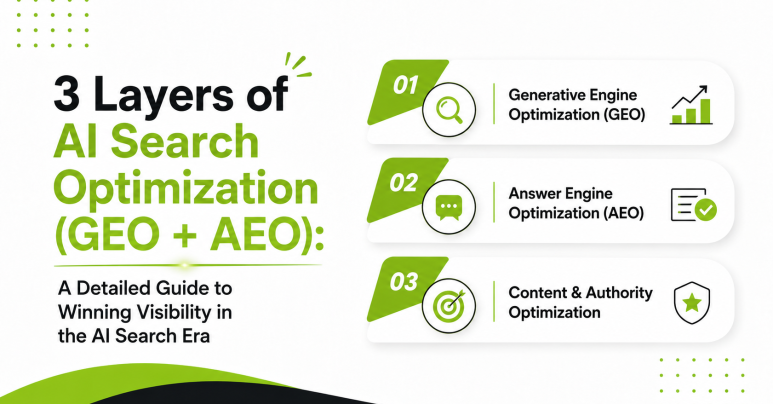
Search behavior is undergoing a major transformation. Traditional search engines are increasingly being supplemented — and sometimes replaced — by AI-powered assistants, conversational search, and generative answer platforms. Today, ranking on search engines alone is not enough.
Businesses must optimize for AI-driven discovery, where answers are generated rather than simply listed. This evolution has led to two important concepts:
• GEO (Generative Engine Optimization) — optimizing content for AI-generated responses.
• AEO (Answer Engine Optimization) — structuring content so AI systems select it as a direct answer.
Major platforms like Google, OpenAI, and Microsoft Bing are shaping how AI search works. Understanding how to optimize for these systems is now critical for long-term digital visibility.
Layer 1: AI Search Foundations (The Visibility Layer)
This first layer ensures your content is accessible, understandable, and trustworthy for AI systems. Without this foundation, advanced AI optimization strategies won’t work effectively.
1. Structured Data & Semantic Clarity
AI models interpret meaning, not just keywords. Proper structure helps them:
• Identify topics clearly
• Understand relationships between ideas
• Extract answers accurately
Schema markup, clear headings, FAQ formats, and logical content hierarchy improve AI comprehension.
2. Entity Presence and Brand Consistency
AI relies heavily on entities — recognizable people, brands, organizations, and concepts. Consistent mentions across:
• Websites
• Social media
• Industry directories
• Media coverage
help AI models recognize your brand as credible.
3. Chunked, Fact-Based Content
AI prefers concise, factual blocks of information:
• Short paragraphs
• Bullet points
• Clear definitions
• Data tables
This makes it easier for AI systems to extract and cite your content.
4. Crawlable, AI-Friendly Formats
AI systems often pull from indexed web content. Key technical factors include:
• Clean URL structures
• Fast-loading pages
• Mobile optimization
• Accessible HTML formatting
This ensures both search engines and AI systems can access your content easily.
Layer 2: GEO + AEO Strategy (The Answer Optimization Layer)
Once your foundation is strong, the next goal is to become the source AI systems choose when generating answers.
1. Answer Framing Techniques
AI systems prefer:
• Direct answers early in content
• Concise explanations
• Contextual examples
Content structured like FAQs, guides, and explainer articles performs well.
2. Multimodal Content Optimization
AI increasingly processes multiple content types:
• Text
• Images
• Tables
• Infographics
• Videos
Using multiple formats improves comprehension and citation chances.
3. Voice & Conversational Search Optimization
With voice assistants and AI chat interfaces growing, conversational content matters:
• Natural language writing
• Question-based headings
• Simple explanations
This improves performance in spoken or conversational AI searches.
4. Retrieval-Augmented Generation (RAG) Compatibility
Many AI systems use retrieval frameworks to fetch accurate data before generating answers. Content that works well with these systems typically:
• Contains verified facts
• Uses clear referencing
• Maintains topical authority
This increases your chances of being cited in AI-generated responses.
Layer 3: Advanced AI SERP Strategy (Authority Layer)
This is the highest level — where brands move beyond visibility to influence AI-generated narratives.
1. Cross-AI Platform Optimization
Different AI platforms may interpret content differently. Ensuring consistency across:
• Websites
• Knowledge bases
• APIs
• Content hubs
helps maintain strong AI presence.
2. Brand Sentiment Management
AI models consider reputation signals:
• Reviews and testimonials
• Media coverage
• Industry authority
Positive sentiment increases recommendation likelihood.
3. Predictive GEO Strategies
Forward-looking brands analyze emerging AI search patterns to:
• Create future-focused content
• Anticipate questions users will ask
• Establish early authority
This proactive approach gives a competitive advantage.
4. API-Based Content Distribution
Some organizations now feed structured data directly into AI ecosystems via APIs, ensuring:
• Accurate representation
• Faster updates
• Better citation consistency
This is becoming increasingly common in enterprise AI strategies.
Why AI Search Optimization Matters More Than Ever
Key shifts driving this change include:
• Users increasingly prefer direct answers over search results lists.
• AI assistants are becoming trusted information sources.
• Authority is now measured by citation, not just ranking.
Ignoring AI optimization could reduce brand visibility even if traditional SEO rankings remain strong.
Practical Steps to Start AI Search Optimization
Immediate Actions
• Structure content for clarity and factual accuracy.
• Build consistent brand authority across platforms.
• Create answer-focused content.
• Use multimedia and structured data.
• Monitor AI mentions of your brand regularly.
Future Outlook: Where AI Search Is Heading
AI search will likely continue evolving toward:
• Personalized conversational experiences
• Real-time data integration
• Predictive search behavior
• Authority-driven recommendations
Brands that adapt early will gain long-term competitive advantages.
Final Takeaway
AI search optimization is not a replacement for SEO — it’s the next evolution.
Layer 1 builds visibility.
Layer 2 earns citations.
Layer 3 establishes authority.
Organizations that embrace GEO and AEO today will be the ones dominating tomorrow’s AI-driven search landscape.


